The broadband industry has hit an inflection point—and the data makes it clear.
- Over $80B+ in telecom M&A took place in North America in 2024 (Bain & Company)
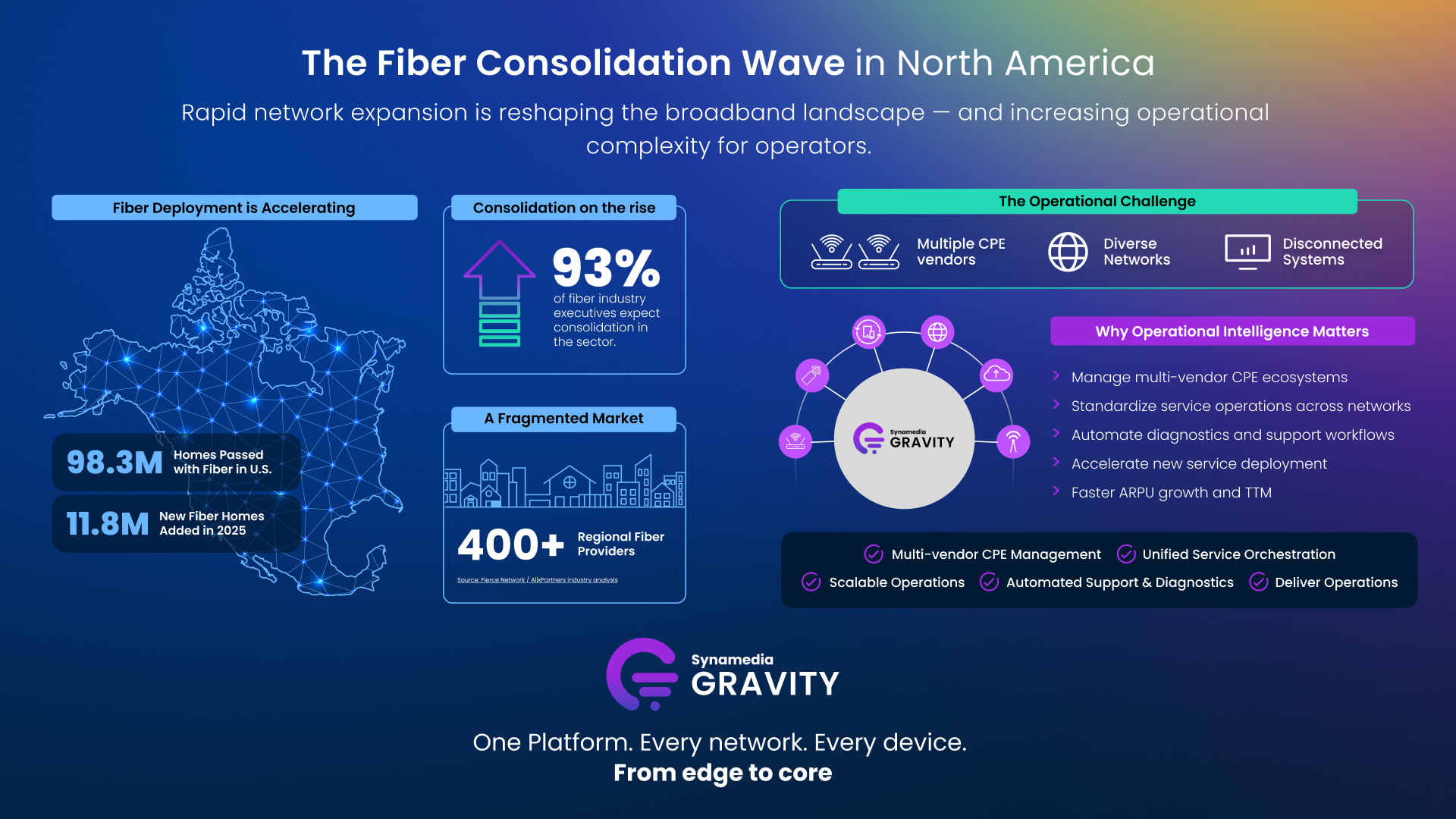
- 93% of telecom executives expect consolidation to accelerate, with more than 400 smaller fibre providers likely to be acquired (AlixPartners)
- Fibre now passes ~100M U.S. homes, or ~60% of households, with growth continuing at record pace (Light Reading)
- Fixed wireless has surged past 14M subscribers, intensifying competition (Ericsson Mobility Report)
- Meanwhile, as broadband growth has slowed to ~2–3% annually, over 70% of operators are actively pursuing M&A strategies to gain scale and efficiency (Fierce Network)
What’s less obvious—but more critical—is that scale alone is no longer a competitive advantage unless it’s operationalised. Against this backdrop, the recent GFiber and Stonepeak announcement isn’t surprising—it’s inevitable.
This represents a structural shift of organisations recognising that understanding how to manage the operational complexities that come with consolidation is where the real value lies.
The assumption that consolidation leads to simplification is fundamentally flawed. In reality, consolidation multiplies operational demands that must be addressed. In this blog, we will outline the current field of play and what’s needed to stay ahead of the pack.
The New Consolidation Wave
Over the past 12–18 months, operators, private equity firms, and infrastructure investors have been aggressively combining assets:
- Stonepeak + Alphabet → GFiber + Astound
- AT&T → Lumen Mass Markets Fiber (~$5.75B)
- Verizon → Frontier (~$20B EV)
- Charter → Cox (~$21.9B)
- T-Mobile → UScellular (~$4.3B)
- BCE (Bell Canada) → Ziply Fiber (~$3.6B)
- T-Mobile + EQT → Lumos Fiber
- Cable One → full control of Vyve
This activity spans telco, cable, and fiber operators alike.
The objective is clear: Build fewer, larger broadband platforms with the scale to compete nationally.
But the reality is more nuanced: operators are scaling faster than they can integrate.
Why Consolidation Is Accelerating
1. Fibre Is the Strategic Asset
Fibre has become the foundation for everything—5G backhaul, enterprise services, AI-driven traffic growth, and next-gen residential experiences. But owning fibre is no longer enough—operators must extract operational efficiency and service agility from it.
2. Capital Efficiency Is Critical
With rising build costs and funding scrutiny, operators are prioritizing:
- Shared infrastructure
- Reduced operational overlap
- Faster ROI on expansion
At the same time, external pressures—such as regulatory scrutiny on new CPE approvals and rising component and memory costs—are forcing operators to extend device lifecycles and do more with existing infrastructure.
3. Convergence Is the Endgame
The market is shifting toward unified service platforms:
- Fixed + mobile bundles
- Residential + SMB offerings
- Connectivity + value-added services
The Hidden Cost: Operational Complexity
But consolidation doesn’t simplify operations—at least not at first.
It introduces fragmentation:
- Multiple OSS/BSS environments
- Different CPE vendors and management platforms
- Disjointed provisioning and support workflows
- Inconsistent subscriber experiences
What was previously manageable at a smaller scale becomes exponentially harder in a consolidated environment. This creates real risk:
- Slower integration timelines
- Delays in launching new services
- Increased support costs
- Customer experience degradation
Critically, integration delays now directly impact revenue realisation—turning what should be growth into operational drag. In many cases, the operational burden offsets the benefits of scale—at least in the near term.
Where Platforms Start to Break
The traditional playbook—rip-and-replace or force standardization—no longer works.
Today’s operators are managing:
- Fibre + DOCSIS + Fixed Wireless Access (FWA)
- Multi-vendor CPE environments
- Networks acquired through M&A and funding programs
Trying to standardize everything into one stack:
- Slows innovation
- Increases cost and risk
- Delays time-to-value
How Synamedia Gravity Fits
This is where a different model is emerging—and where Synamedia Gravity aligns directly with the needs of a consolidating market.
Operators don’t need another platform; they need an operational control layer that works across what already exists. Rather than forcing uniformity, Gravity is built to operate across complexity.
1. Vendor-Agnostic by Design
In a post-M&A environment, ripping and replacing platforms isn’t realistic. Synamedia Gravity works across vendors and existing deployments—allowing operators to unify operations without disruption.
2. Agentless Architecture
With no software required on devices, operators can quickly onboard newly acquired networks and CPE—accelerating integration timelines.
3. Single Pane of Glass Across Access Types
Fibre, DOCSIS, and FWA can all be managed on a single platform, which is critical as networks converge.
4. Faster Time-to-Value Post-Acquisition
Operators can:
- Gain visibility across networks quickly
- Streamline provisioning and support
- Maintain service continuity during transitions
5. Pay-As-You-Grow Economics
As operators scale through acquisition and expansion, Synamedia Gravity aligns with incremental growth—not large, upfront transformation projects.
Consolidation Isn’t Slowing Down—It’s Accelerating
The direction of the industry is clear:
- Fewer operators
- Larger platforms
- More complex networks
Consolidation doesn’t create value. Operational control does.
Conclusion
In a market where speed, flexibility, and openness define success, Gravity lets you modernize at your own pace—without disruption. It gives service providers the freedom to choose—and the power to lead.
- Faster ARPU Growth and Time to Market
- Smarter Operations with a single pane of glass
- Lower Costs with no agent integration or certification delays
- Future-proof with open standards and modular design
Learn how Synamedia Gravity can transform your device and service management operations.