Edge Watermarking: Shortening the Distance from Piracy to Disruption



For premium video services, piracy is no longer a theoretical risk. For live sports, early-window movies, and high-value series, illegal re-streams can appear within minutes — sometimes seconds — of first availability.
Digital rights management (DRM) controls access, but once a stream escapes the ecosystem, a different question becomes critical:
Whose copy is this — and how quickly can we act?
That’s where invisible forensic watermarking earns its place in modern content protection strategies.
Invisible (or forensic) watermarking embeds an imperceptible identifier directly into the video signal. Unlike DRM, which enforces playback rules, watermarking enables attribution: when a pirated copy is discovered, the watermark reveals which legitimate session, account, or distribution point it originated from.
In adaptive streaming environments, watermarking is most commonly implemented using A/B watermarking:
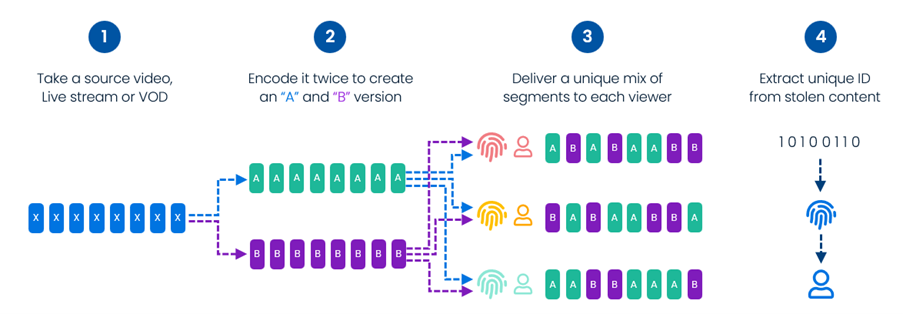
This approach is well understood, widely deployed, and standardised within the DASH ecosystem. It integrates cleanly with existing ABR workflows and scales well across CDNs.
But it also comes with some very real constraints.
A/B watermarking encodes identity one bit per segment. In practice, that means:
Pirates know this.
Rather than trying to “remove” a watermark — which is extremely difficult — sophisticated attackers focus on disrupting detection:
The watermark is still there — but attribution takes longer. And in piracy operations, time is money.
Every extra minute before identification is another minute of monetisation.
The goal of modern watermarking isn’t theoretical robustness. It’s operational effectiveness:
Reducing the time window to actionable confidence has become the defining metric.
This is where edge watermarking fundamentally changes the equation.
Edge watermarking shifts watermark insertion from the head end to the very edge of the CDN, leveraging edge compute and compressed-domain watermarking techniques uniquely enabled by Synamedia ContentArmor.
Rather than pre-generating and switching between A/B variants, watermark payloads are inserted dynamically at the edge, directly into the compressed video – even on encrypted content – without full decode and re-encode.
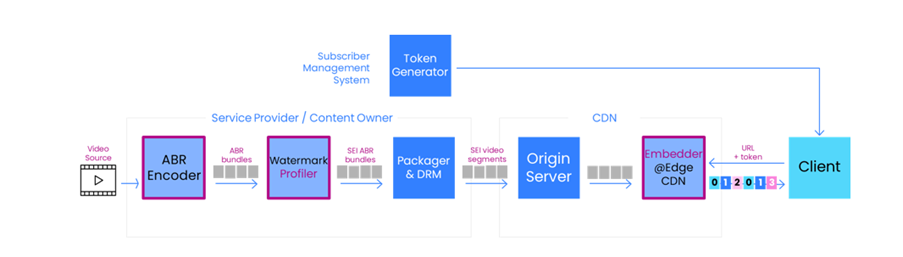
This architectural shift delivers several important advantages:
1. Faster payload accumulation
Watermark insertion is no longer tied to segment boundaries or limited to one bit per chunk. Payloads can be embedded at a higher effective rate, allowing identification confidence to build earlier in the stream.
2. Reduced effectiveness of sequence-breaking attacks
Because watermarking is self-synchronising and independent of rigid segment sequencing, common pirate tactics — dropped segments, jitter, and stream splicing — are far less effective at delaying attribution.
3. Lighter head-end, simpler workflows
The head-end no longer needs to manage variant explosions or tightly synchronised insertion logic. Complexity moves to where scale already exists: the CDN edge.
4. Security preserved end-to-end
Watermark insertion occurs without exposing clear video, maintaining existing encryption and DRM trust models while adding forensic traceability.
In internal proof-of-concept testing, this approach demonstrated tens of milliseconds of additional edge latency at high percentiles — a small and predictable trade-off for materially faster detection and disruption.
Pirates exploit the natural latency of watermark detection. ContentArmor Edge watermarking flips that dynamic.
By shortening the time needed to reach attribution confidence, edge watermarking reduces:
It doesn’t claim to make piracy impossible — nothing does. It makes piracy less profitable, less persistent, and easier to disrupt.
That’s the real win.
At Synamedia we’ve fused our industry-trusted ContentArmor technology with our video-centric CDN product Fluid Edge, representing a meaningful evolution in content protection: one that aligns watermarking speed with the realities of modern piracy and live streaming economics.
We demonstrated ContentArmor Edge Watermarking—including encrypted, compressed-domain watermark insertion at the CDN edge—at NAB 2026.
If you’re rethinking how quickly your organisation can move from pirate detection to decisive action, we’d welcome the conversation.
Robin Oakley, Senior Director, Edge CDN Solutions
Robin Oakley is Senior Director for Synamedia’s Edge CDN solutions. He is responsible for driving strategy and growth for Synamedia’s portfolio of smart and cost-efficient CDN technologies. With over 20 years’ experience in the broadcast technology industry, he has worked for many of the industry’s biggest brands, including Discovery and MTV, leading diverse projects and teams around the world. Robin’s expertise covers a wide range of content distribution technologies including DVB, IP and OTT streaming.
Most recently he spent seven years at DAZN as VP, Distribution Engineering, where he built and led a team responsible for the streaming distribution of thousands of live sporting events to millions of subscribers globally.
Robin is based in the United Kingdom and has a Bachelor of Science degree in physics and chemistry from the University of Leeds.



Sign up to Synamedia events and news